Thursday, September 25, 2014

In-Class Blog - Educational Games Research

For the past two days, I have been looking up various sources to help myself better understand the connection between games and education and how to bridge the two together to create a game that is both fun and informative.  Below are just some of the sources that I have found.


     This short article gave me an understanding of taking the video game Pokemon - a game associated with traveling an in-game world and battling creatures with other creatures - and making video games that help with promoting learning and understanding basic fundamentals.  While only based in New York at the time of the article, the prospect of learning from video games is still a great source to teach children the fundamentals of different educational subjects.
     "Pokemon Introduces Software For Grades 3-6 Math, Science And ELA." Electronic Education Report 13.13 (2006): 7. Business Source Elite. Web. 25 Sept. 2014.


     The article "Using Virtual Reality with and without Gaming Attributes for Academic Achievement" discusses the educational value of using virtual reality verses using traditional, non-gaming methods.  Despite the study's result on language arts skills not finding a significant difference between the two, the study still showed that future games should take a more simulation-focused attitude and it should be integrated into future gaming tech.
     Vogel, Jennifer J., et al. "Using Virtual Reality With And Without Gaming Attributes For Academic Achievement." Journal Of Research On Technology In Education 39.1 (2006): 105-118. ERIC. Web. 25 Sept. 2014.


     This article goes into great detail about computer games and how learning through these digital games can become another resource for education.  It goes in-depth to discuss why computer games should be considered an option in education as well as acknowledging that there will be some dissenters who will insist on what the article calls "nineteenth-century methods of rote learning, telling, and testing".  Prensky, the article's author, does an excellent job in giving examples of how computer games could become a new and interactive way to educate children as well as how to go about making these games both engaging and fun while also being instructive and educational.
Prensky, Marc. "Computer Games and Learning: Digital Game-Based Learning."Handbook of computer game studies 18 (2005): 97-122.  Web.  25 Sept. 2014


     "Game Design as Narrative Architecture", an article written by Henry Jenkins, discusses the debate between narrative versus gameplay and how such a debate could help games become a more engaging, yet interactive medium.  While not necessarily related to education, he does bring up several good points throughout the article, including mentioning that "not all games tell stories" and uses different games to reiterate his points.  This article made me realize that while having a narrative isn't necessarily going to make or break a game, making sure to give the player an opportunity to feel like they are a part of the experience definitely made me ponder on gaming in general.
Jenkins, Henry. "Game design as narrative architecture." Computer 44 (2004): s3.  Web.  25 Sept. 2014


     "It's All in the Game" - a clever title to a clever article - focuses on the educators of today and how they can be certain that a child has the opportunity to develop necessary communication skills and talents.  Using a science teacher's use of a board game to teach children about the ecology of a rainforest as an example, the article continues into describing how games can allow children to express themselves in a more friendly way that allows kids to feed their curiosity about various topics and how games can be effective tools for education.
Collins, Kathleen M., et al. "It's All In The Game." YC: Young Children 66.2 (2011): 12-19. Education Research Complete. Web. 25 Sept. 2014.


     Finally, the article that I found the most interesting to read, "A Look Inside a MUVE Design Process: Blending Instructional Design and Game Principles to Target Writing Skills" discusses the benefits and increased number of various interactive mediums such as games and virtual environs over the past ten years.  It acknowledges that, while reports have not yet showed that the "design processes" needed to create various complex and intricate spaces of learning, there is great promise in using virtual media to promote creative learning using different design choices to match them with the appropriate educational instruction.  This gives hope to the future that traditional board games and video games, as well as gaming in general, can be used and widely acceptable forms of education.
Warren, Scott J., et al. "A Look Inside A MUVE Design Process: Blending Instructional Design And Game Principles To Target Writing Skills." Journal Of Educational Computing Research 40.3 (2009): 295-321. Education Research Complete. Web. 25 Sept. 2014.

Thursday, September 11, 2014

Warriors of Light - The Beginning of a Legend


(Video from Youtube.com)

The Beginning of an Era

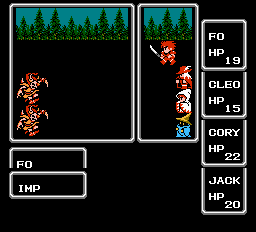
     The game that started it all, Final Fantasy (also called Final Fantasy I), was the last breath of hope from Squaresoft in 1987, a company that was facing bankruptcy at the time.  Inspired by games such as Ultima and Wizardry, the game focuses on the a party of four playable characters through dangerous locales, small towns and villages, and fierce battles in a turn-based combat system.

The battle system from the first Final Fantasy game.
(Image from the Final Fantasy Wiki)
     The story is a simple one, but the themes of which would continue to echo into other games in the franchise for years to come.  Four Warriors of Light, unnamed in the original game, travel the vast world around them to stop the evil knight, Garland, from bringing darkness to the realm.  While the story in its first iteration was simple for its time, its idea of "Warriors of Light" carrying the burden of saving the world from being engulfed in darkness and ultimately prevailing would later be synonymous with the series in future Final Fantasy titles.

     The ideas set in the Final Fantasy game would later become the popular mainstay of many other Role-Playing Games preceeding it, both in terms of future installments of the Final Fantasy series as well as games outside of the franchise by other companies, where the turn-based combat would be the major influence of the game.

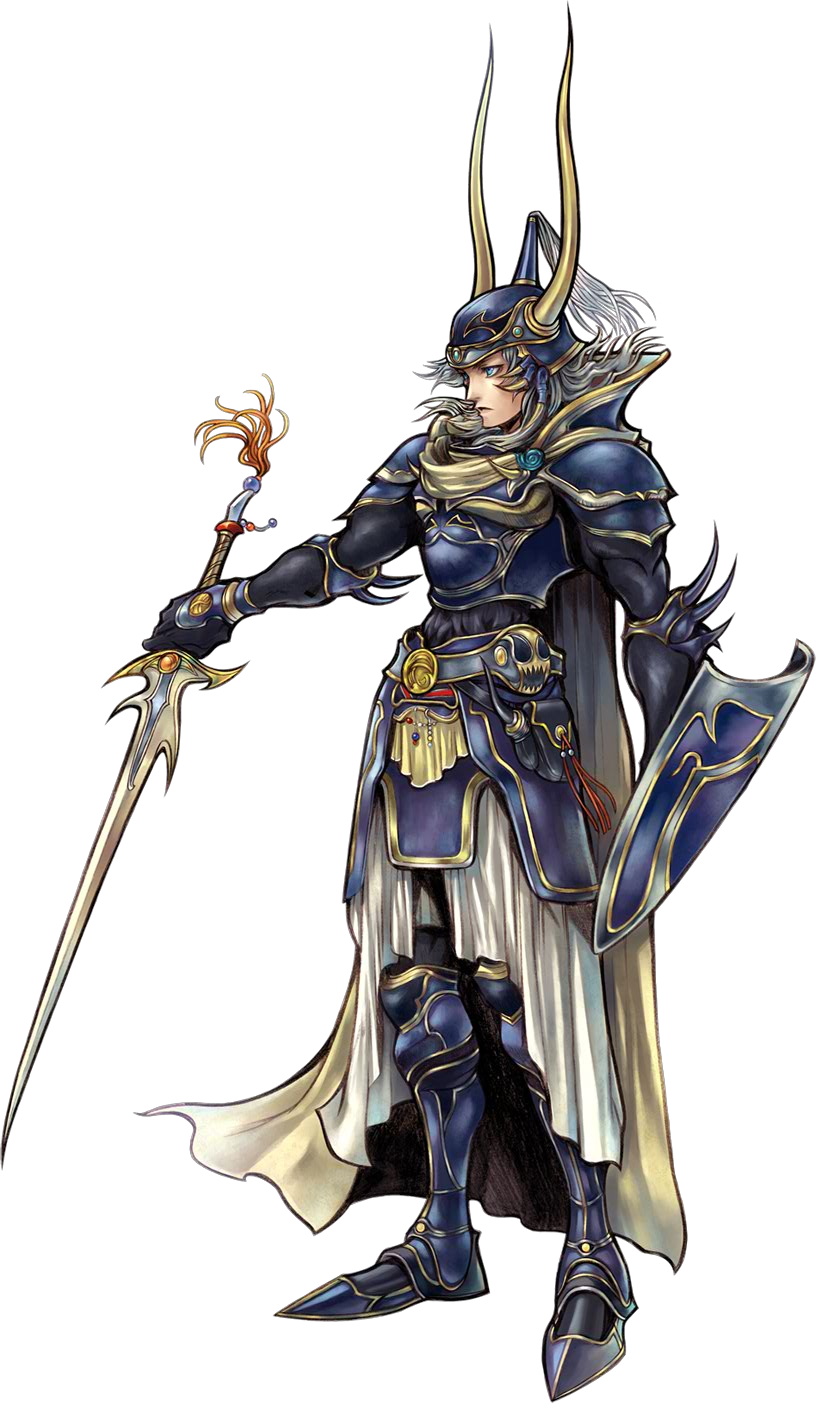
The Warrior of Light, as depicted by Tetsuya Nomura
(Image from the Final Fantasy Wiki)
     While originally called orbs, the series would later be known for its iconic theme of crystals and a battle between light and dark.  Among other icons (such as the Chocobo, Moogle, and Cactuar, for instance), the 'crystal' theme would be prevalent in future games in the series.  Also carrying over are, again, the theme of Warriors of Light - people who were bestowed power, in one way or another by the crystals, whom would then go on to combat the forces of darkness that threaten to destroy or attack their world.

     The game also introduces the baseline idea for the series iconic class/job system (which would not technically be realized until Final Fantasy III and later established in Final Fantasy V).  Mostly known to be a Final Fantasy staple, this system allowed the player to customize their party of heroes to whatever configuration they chose best.  The original game established the series' first six classes, which would later become the iconic classes and jobs in the franchise - Warrior/Fighter, Monk/Master, Thief/Ninja, White Mage/White Wizard, Black Mage/Black Wizard, and Red Mage/Red Wizard. These six classes (which would be upgraded into jobs later in the game) would set the series' original jobs that would become even more pronounced as each new game added to the system.

     Final Fantasy was one of the most influential role-playing games to hit consoles during the late 1980s.  While other games such as Dragon Quest introduced gamers to the concept of a role-playing game, Final Fantasy helped to push the genre into the limelight of popularity.  The first Final Fantasy has been re-released on various other platforms, each re-release having improved graphics, sounds, and even added bonuses.  Today, the game can be found on platforms such as the Game Boy Advance, the PlayStation Portable, and even on your smartphone or tablet.

Tuesday, September 2, 2014

Cast: [Raise] - The "Final Fantasy" of Squaresoft and it's Impact on the Gaming Industry

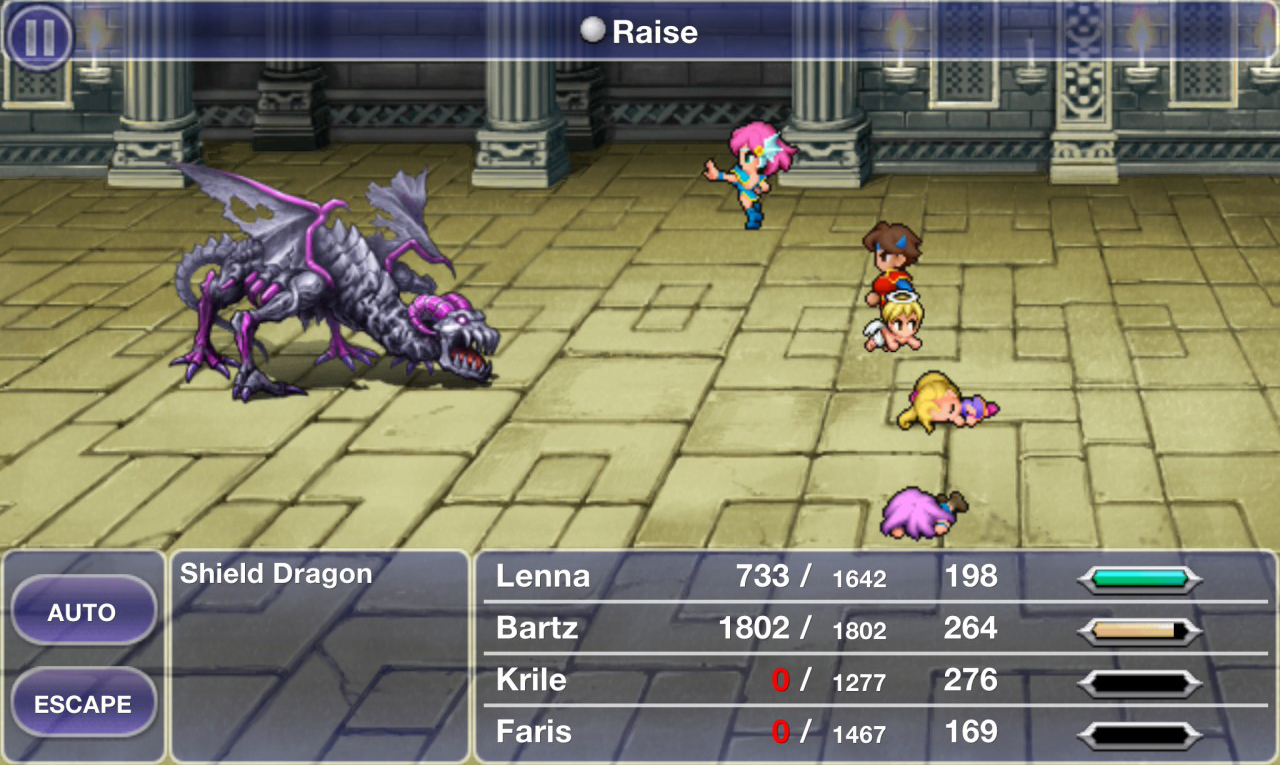
Krile died again...
(Image from finalfantasy.wikia.com)

     The Final Fantasy series of video games have long been established as the holy grail of the video game industry.  Made by a company who pooled the last of their resources in a ditch effort to pull themselves out of a crippling debt, Squaresoft put all of their hopes in this small role-playing game - their last grace...their last "Final Fantasy."

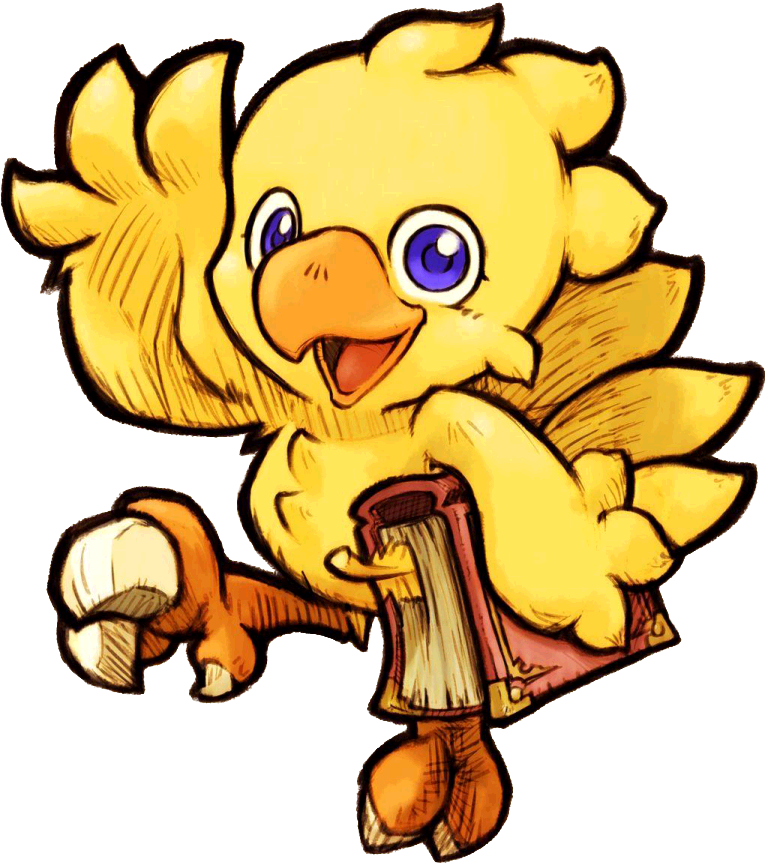
I mean, seriously, this little guy is adorable.
(Image from finalfantasy.wikia.com)
     The game was an enormous success, selling over 400,000 units during its original launch.  Numerous entries into the series were created over the years (with the latest title, Final Fantasy XV, still being in production), each one carrying on the legacy of the series' first entry.  Each game brought us a different land, new experiences, and brand new characters to get ourselves attached to (whether for good or bad), all-the-while solidifying familiar elements such as the game world's currency, Gil, or the fan favorite iconic characters like the Chocobo and Cactuar.


     It is a series that left a lasting impression on the world.

     And it all started....


          ...with one company's "Final Fantasy."


     Throughout the semester in the Game Design class, I will be discussing each major title in the series and its impact in the industry and on the genre as a whole - how its simple turn-based gameplay revitalized an entire genre while engrossing the player in a captivating world and story - as well as a brief look into the story that unfolds during each game.  So saddle up some Elixirs and grab some friends, because this adventure is about to begin!

Thursday, May 1, 2014

Final Blog - Comic Strengths/Weaknesses.

After finishing my comic and reading it over, I am happy to say that I am proud with how my comic turned out.

In terms of strengths, I feel that the visuals and the interactions between the characters are the comic's strong points.  Each character has different poses that give emotions between each conversation and interaction throughout the comic.  Another thing that I really liked was how the models themselves turned out.

However, if there's one thing that my comic is weak in is the usage of onomatopoeia.  I feel that I should have done a little more onomatopoeia words to sound out more actions in the comic.

Saturday, April 26, 2014

Blog 5: Animation and Mood

            "In most instances, the driving force behind the action is the mood, the personality, the attitude of the character--or else all three.  Therefore the mind is the pilot.  We think of things before the body does them."  This quote by Disney is a summation of how the mind and its many chemical and neurological processes work in conjunction with the body - in essence, these 'signals' that convey messages between the brain and the body.
            In order to understand this and apply this to animation, it's important to remember that the key to conveying a realistic (even if exaggerated) animation is to understand the way in which the body moves and the processes behind that movement.  Take, for example, moving your arm.  Just the simple action of moving it - again, this is a basic and general description - is generating a neurological signal from your brain to the nerves in your arm, which then causes you to move your arm.  While very simple, the process behind this also carries over into animation.

            Whether it be moving a limb or using the mouth to speak, the idea is that behind each physical movement is a neurological 'pilot' to guide the correct and appropriate action to the correct appendage or area of the body.  When speaking, your mind is forming the words used to communicate orally using sound and motion of the mouth.  The same process carries over into animation. 

Blog 4: The Real and Realism of Animations

             When taking in Walt Disney's quote, there is a fundamental understanding behind his words.  "I definitely feel that we cannot do the fantastic things based on the real, unless we first know the real" is a quote that still holds true to this day.  To interpret his quote, Disney is stating that unless we know how real objects move, feel, weigh, and interact with other objects, our animation will not have the same quality of 'life' than if you knew the real, physical properties of the way objects exist in our world.

            When comparing Disney's quote to Chapter 2 of 'Illusion of Life', the two seem to go hand-in-hand, as Disney himself prided and focused on bringing life to his works.  The amount of time that it takes to create a semblance of life in each frame of animation requires an understanding of the properties of different materials, movements, forces, and mechanics.  This leads into the idea that without proper understanding of real-world physics and motions, the animations we can create will not have the same vibrant 'life', on screen, that exists in our world.

Blog 3: The Twelve Animation Principles According to Disney

            In animation, there are twelve different principles of animation.  The first (and most important), Squash and Stretch, is a simple term detailing the stretching or squashing of a fixed shape.  Think of a ball bouncing up and down on the floor.  When animated, the ball will squish when it makes contact with the 'floor', followed by stretching when it lifts from the ground and back into the air.

            The second principle is Anticipation, which is a planned sequence of events. For the most part, many animations are a sequence of planned events with which the audience may expect to occur between each key frame of animation.  Going back to the ball, we know that objects have a certain weight to them.  With a ball, we expect it to drop from its starting point (either from a hand or a table) and hit the ground, followed by the resulting motion of it bouncing back into the air.

            Staging is the third principle of animation that focuses on the presentation of any idea that it is both unmistakable and completely clear.  A good example of this would be any Tom and Jerry cartoon (https://www.youtube.com/watch?v=nVW_rTqo4bs).

            Straight Ahead Action / Pose to Pose is the fourth of the twelve principles.  While 'Straight Ahead Action' focuses on working straight from the first drawing in the scene (think of a batter in Baseball and how he will swing the bat when the baseball comes by the home base).  Pose-to-pose, however, relies on the animator planning the action out, figuring which drawings will be needed to animate the action, drawing the key frames, relating them to each other in both size and action, then giving the scene to his or her assistant to draw the in-between frames.

            Follow Through / Overlapping Action, the fifth principle, is a rather interesting one due to it being broken into five main categories.  In base terms, however, the concept is that a figure and all of its appendages (whether it be a feather or a coat or what-have-you) must carry some weight and therefore must be animated along with the object or figure to give a sense of the believability, regardless on if the action is broadly cartooned or not.

            Slow In / Slow Out is a principle in which in-between frames of an animation are so close together (almost extremely close to each pose frame) that they make a smooth transition from one frame to the next without  the animation having to suffer from pauses when transitioning from frame to frame.

           Arcs are the seventh principle in which most living creatures will follow a circular motion (albeit slight).  A good example of this is watching a walking animation and taking note of the almost circular motion that the object makes after taking each step.                                                          

            Secondary Action, the eighth principle in the set of twelve, is one that gives a scene its characteristic 'life'.  Not only that, but the main focus is that they emphasize the main action (instead of taking attention away from it).  An example of this would be a woman walking whilst rummaging through her handbag.

            Timing, the ninth principle, refers to the number of frames for a specific, given action, which then translates to the actions speed when processed into a film.  This is one of the most important principles of the twelve, as it heavily influences not just the object's perceived weight, but also how it mirrors the laws of physics by giving the figure or object a perceived motion and weight.

            Exaggeration, the tenth, is the style of giving a realistic item or object an exaggerated look to give said object or item a sense of 'life'.  To note, the level of exaggeration is varied by the artist's style and whether one seeks to create something using realism or a caricature.

            Solid Drawing is to give the object or item a sense of being three dimensional in the sense of both space and weight.  In animation, this applies to the artist/animator knowing and understanding the fundamentals of three-dimensional shapes, the shape's anatomy, its weight, and its effect of light and its resulting shadow, among others.


            Appeal, the final principle of the twelve, is the act of making the character a sense of realness - that is, making it so that the viewer or audience is attracted to the character(s) due to the character's behavior, likability, and is interesting to the viewer.

Blog 2: Caricaturing Reality...or Realistic Exaggeration

            A caricature is, by definition, "a picture, description, or imitation of a person or thing in which certain striking characteristics are exaggerated in order to create a comic or grotesque effect.”  In animation, this applies to a character, background, or object that takes its real-world properties and effectively stretching them to make them unreal or largely out-of-proportion to its real-world counterpart (for example, a standard butter knife in reality could be stretched to be an unwieldy sword).  This, in turn, gives the work a more interesting and original feel to it that otherwise would go unnoticed by the audience or by the creator himself.
            What is interesting to note, however, is that caricature and realism are both opposites of the same coin in a sense.  On one hand, caricatures focus on the absurdity and out-of-proportion features that differ them from realistic properties and equivalencies.  Realism, though, differs in that it takes what we perceive to be real and keeping those proportions within the same boundaries.

            To compare, think of a sword from an animated short or film and then think about a sword that you would see in a museum.  While we perceive them to both be swords, the animation version will differ greatly from the real-life counterpart.  For instance, the caricature version of the sword might focus on a larger hilt or the blade will be comically longer or heavier looking.  In that sense, caricatures are - depending on your view - truer than realism in that the creator has more freedom with how to carve these objects out than he would if he based them exactly like their realistic versions down to the most minute detail.

Blog 1: Communications - The Basics of Conveying Ideas

            One of the basic fundamentals of communication stems from the idea of two or more beings interacting with each other.  With this in mind, the same basic principle applies to mass communication, albeit on a larger scale.  Whether it be through speech, text, or motion, communication is the prime outlet with which we, as humans, convey a wide range of ideas and emotions between one another.
            This also applies to animation, as communication between the creator and the audience is a bond that relies solely on being able to convey any idea, thought, or emotion.  Just as the creator brings these things to life, so too must the audience be able to understand the creator's manifestation of his or her ideas.  This back and forth "conversation" between audience and medium heavily relies on the creator's ability to convey such communication in an easily understood way, otherwise the message being conveyed will be lost.

Monday, January 20, 2014

Maus and the Comic Triangle Concept

Throughout the first chapters of the book Understanding Comics, many concepts are brought up regarding comics and how they can convey not just ideas and concepts, but also convey messages of differing meanings.  One such concept, a chart that appears on page 51 of the book (also on pages 52 and 53 for a better understanding of the chart), connects pictures, realism, and language into a triangle that represents the "pictorial vocabulary of comics or of any of the visual arts" (51).

To give a brief summary, the triangle works like this:

- The closer to language, the simpler the art becomes
- The closer to realism, the more realistic the art becomes
- The closer to the picture plane, the more that each individual line, shape, and color can be themselves and not pretending to be something else.

For the purposes of this reflection, we'll be ignoring the the picture plane part, as that mostly deals with art being art and not to convey a narrative or idea.

This concept lends itself very nicely towards Maus.  One of the most noticeable things is that, art-wise, the comic centers around generally stylized (but still simplistic-looking) anthropomorphic animals, each one symbolizing a different nationality/race/religion - the most notable being that the Jewish people are represented as mice while the Nazis are represented by cats.  While still having mostly detailed backgrounds (with the occasional panel dark and detail-less background), the characters themselves lend their simplicity to give the illusion of realism while not being real.

Language-wise, the story is told through the eyes of a Jewish survivor from World War II.  Going back to what I said earlier, the fact that the art of the story is told using anthropomorphic animals lends itself to the dire and bleak times facing the Jews during the war.  Not only does the cat-and-mouse visual idea lend itself well to the story, but it also gives the reader a sense of the visually horrifying nature that Jews faced during WWII.

Maus' WWII narrative roots and the artistic anthropomorphic style of cat-and-mouse gives the reader a more visual idea of the horrors of WWII that befell the Jews.  Using this chart's concept helps give the reader a better understanding of Maus' mature theme.  When used correctly, as in the case of Maus, the chart can be the best weapon a person can have in creating a comic that best suits its focus - both in visual and narrative sense.

Thursday, January 16, 2014

In-Class Assignment - Frames

During class today, we discussed how frames work in comics/graphic novels and how their layout can subtlety convey messages that our subconscious recognizes.  


The image above, found in issue 46 of the comic 'Transmetropolitan', demonstrates this concept precisely and cleanly. In it, the main character (named Spider Jerusalem), reflects on his current predicament after the events that occurred in the issue preceded this one.  He eventually concludes that he is in a coma after realizing that he is still alive (which he references when he alludes to God "giving up his throne to" Spider).

The layout of the two panels brings this image together of Spider's comatose isolation. The thin, white line between the two panels subconsciously brings up the feeling that the balance between Spider's life and a vegetative state is fragile, almost as if ready to crumble at a moment's notice.  The excessive use of black ink surrounding Spider also helps convey his imaginative self suspended in a mental space devoid of everything but his own mental likeness.  It projects to the reader that in this state, Spider is surrounded by a darkness that has resulted from his coma.  This darkness, along with the shading of Spider's face accenting his grim but self-philosophical reflection, adds itself to this image of being trapped within one's own mind.

Monday, March 18, 2013

VALS Assessment and Thoughts

Striver/Experiencer

     These are the two words that stare back at me after completing the VALS assessment test.  To be honest, I actually think these two words really reflect my interests and my personality to almost a T.  It's...also rather odd, all things considered.  Most of the questions asked mostly about life things and about faith, ideals, and the like instead of asking about aspirations, life goals, and things I would normally assume to be on things such as this.

     However, I do realize now that, after taking this assessment, I learned that I always feel like I need to experience new things, as well as being told flat on my face that, as a Striver, I have a problem with impulse buying (which isn't too far from the truth, as I sometimes have the urge to purchase a bar of Laffy Taffy every time I go through the checkout at my local grocery store or at least buy a booster pack of Magic: The Gathering cards from the nearby hobby shop).  However, I also know now that, as an Experiencer, I tend to love new things - video games and books, especially - that give me a sense of adventure and a certain freedom to travel the world that I, as I am now, cannot and are unable to do.

     If I was asked how my interests would be used to appeal to me as a consumer, I'd ask to be directed to the either the local Books-a-Million or GameStop store, as these are probably the only two ideal places in the world where I would literally have to be escorted out of the building at closing since there would be about half the store that I would love to own or purchase, despite my lack of income.  Throw me a good video game with an interesting cast of characters and an engaging, interactive story and gameplay, or a book that sounds less like a bad Twilight fan-fiction and more like an original work of fiction, and I would practically throw my money at you with due-haste.

     That reminds me.  I must start writing video game reviews again.  I have been too terribly bogged down with a collection of games I have yet to play and not enough time to really sit down and play them.

Monday, February 18, 2013

The Future of Music Podcast

Podcast Title: The Future of Music


Release Date: Feburary 18th, 2013 (tentative)


Podcast:

Summary: This podcast is aimed at briefly going over music and its interaction with technology throughout the years. Also quickly delves into the range of music genres that have spawned from said technological advancements and quick quips on both points of view on whether technology has affected music positively or negatively.


Resources:

Baran, Stanley J. Introduction to Mass Media: Media Literacy and Culture

Asahi TV - Hatsune Miku (Vocaloid Technology)
http://www.youtube.com/watch?v=xBZOlipfjkQ

Auto-tune Technology History
http://www.antarestech.com/about/history.shtml

Guardian Magazine
www.guardian.co.uk/music/interactive/2011/jun/11/history-modern-music-timeline

Timeline of Sound & Broadcast Technology
http://www.classicthemes.com/technologyTimeline.html


Sponsors: Shepherd University, Comm 203 - Comm and New Media

Host: Kevin Wohlrab

Co-Hosts: Mark Eberhardt, Emily Turner

Team Members: Mark Eberhardt, Kevin Wohlrab, Emily Turner

Editor: Mark Eberhardt

Friday, February 1, 2013

Media and Medium - Four Questions/Four Answers

     Often today, you can nary get by a day without technology impacting you in some way, shape or form.  People around you are busy walking here and there, a smart phone in hand, some music in ear, or a snippet of text in sight.  For me, my life has been based solely around technology.  To which I must answer the following questions:

Question 1)  When has the medium proved to be the message in your media consumption?
Question 2)  What is a good example of how new media technology has acted as an extension of your body?
Question 3)  What is prime example of how you engage in the 'global village?'
Question 4)  Based on your reflections on the impact that media has had on you, do you consider yourself a technological determinist or a structuralist?

     To answer the first question, the only really big medium that has proved to be the message in my consumption of media has to be when I first got my first glimpse of the internet as a child.  At the time, the internet was just starting out (before the days of social media sites like Facebook, MySpace, etc.), but back then, it was probably the biggest eye-opener to me.  The fact that - and this is especially true, as when I was young, I had an...let's just say my mind as a kid was more expansive in terms of grasping concepts than today - I could literally communicate with people from all over the world from home (we had this ancient thing called an AOL chat room - I always stuck with the video game sub-chat because I was a huge gamer even at that point of my early childhood).

     For questions two and three, I'll need to go a bit more in-depth and talk about something that I'm pretty sure a vast majority of people know absolutely nothing about it.  In Japan, there are these vocal synthesizing programs called 'Vocaloids', which are essentially "vocalists in a box".  They are software programs designed to take pre-recorded samples from different voice actors and make them into regular singers.  There is also a free version of this synthesizing software called Utau, which allows regular folks, like you and me, to record our own "vocal samples" and, in turn, transform our voice into a vocalists'.  Now, to be fair, I can't really sing.  I always have a hard time hitting a high note (or any high note, for that matter).  But with this software, I can sing (albeit aided by the program).  For me, this is the extension of my body, or more my persona.  For example, my voice is mostly mono-tone and boring.  However, with this program, my voice sounds more like that of a singer's.  Here's a quick sample (it is in Japanese, but it does convey the same point):


     This also ties in with the third question.  With the vocal synthesizing software that I personally use, I have become good friends with other users from all over the world, from other parts of the U.S to the U.K., and even one in Japan.  Without this software, I would not have met these wonderful people or even known they even existed!

     In terms of the fourth question, I find myself to be more of a technological determinist.  Without technology - its improvements and failures - I wouldn't be the person I am today.  I constantly fumble with my smartphone so I can listen to music, look up things on my iPad in-between classes, and play video games with my friends on my computer.

Sunday, January 27, 2013

Copyrights and Copylefts: Their Role in Today's Technological Age And How They Interact with the Internet.

     The Internet is an enigma, constantly shaping and reshaping itself on an almost instantaneous cycle.  Every day, new ideas are created, new topics are discussed, and new images, eBooks, fan fictions, etc. are uploaded to the World Wide Web.  However, one thing that has always been a problem is the use of Copyrights.  For those who don't know, a copyright is, in essence, a legal acknowledgement stating that one or more parties owns an intellectual property.  A perfect example of this would be like if I wanted to make a walk-through of a Legend of Zelda video game, I would not (under any circumstance) be able to say that I owned the rights to the actual game.  It is essentially this: You cannot claim that you own the rights to a property that you don't actually own.

     There have, however, been steps taken to lessen the burden of legal issues stemming from the copyright monolith.  One such step is in the form of the Creative Commons, which is a database of music, video, audio and the like that is free for use to the open public.  These help give those who want to do things, but are unsure if what they're using is leaving them open to lawsuits, the perfect way to express their ideas and convey their messages.  However, there are times where Creative Commons just don't work, especially with media sharing sites such as YouTube, Flickr, Twitter, and so on.  For that, there is what is known as the Fair Use law.  Just like what Stanford University states on their website, "Fair use is a copyright principle based on the belief that the public is entitled to freely use portions of copyrighted materials for purposes of commentary and criticism."  An example of this is someone making a music montage using clips from a television show and overlaying a specific song over the video.

     Now how does this really impact the internet?  Well, it impacts the Internet tremendously.  So much so that, during the proposals for two separate anti-piracy laws called SOPA and PIPA, there was a huge uproar against it (though it mostly went by practically unnoticed by the major media groups).  Officially noted to have the intended purpose of stoping the illegal distribution of copyrighted material on the internet, the bills were actually designed to essentially allow companies to issue cease-and-desist orders against anyone for posting, uploading, or even mentioning a product, in some cases, of media (an example incident would be with Sega flagging videos of the video game Shining Force III on YouTube)!  The bills were, ultimately, voted against.  But the overlooming shadow of having a person's ability to speak their mind on the internet would be their greatest ally  Since the laws , both bills have yet to be reintroduced to Congress and the Senate.

     What do I think of the copyright dilemma?  I believe that the Internet is fine where it is in terms of copyrights and their usage.  Sure there will be times where people file lawsuits against others who go and break the laws of copyright , but a small part of the actual Internet user-base does not make up the Internet community as a whole.  Instead, the fact that we have Creative Commons works floating in existence and the Fair Use law allows us leeway into making user-edited or user-created content.


Wednesday, January 23, 2013

Humble Greetings

Hello gamers and non-gamers. Mark Eberhardt here. And for the next few weeks, you will be assimilated hopefully receive information about specific storylines in video games, how they impact the game as a whole, and whether or not the actual story makes sense and flows fluidly (making sure to explain all plot points along the way).